
By Ritu Gupta
Early lessons from CJRF's work on non-economic loss and damage
As the focus on loss and damage moves from high-level negotiations into actual funding on the ground, our work has surfaced an insight we cannot ignore: non-economic loss and damage cannot be addressed through grants alone. When people lose their culture, their sense of safety, or their very identity, it often shows up as a quiet erosion of community life, a weakening of care systems, and a painful disconnect between generations. These losses are heavy and intangible, and they require approaches that can hold uncertainty, complexity, and genuine care.
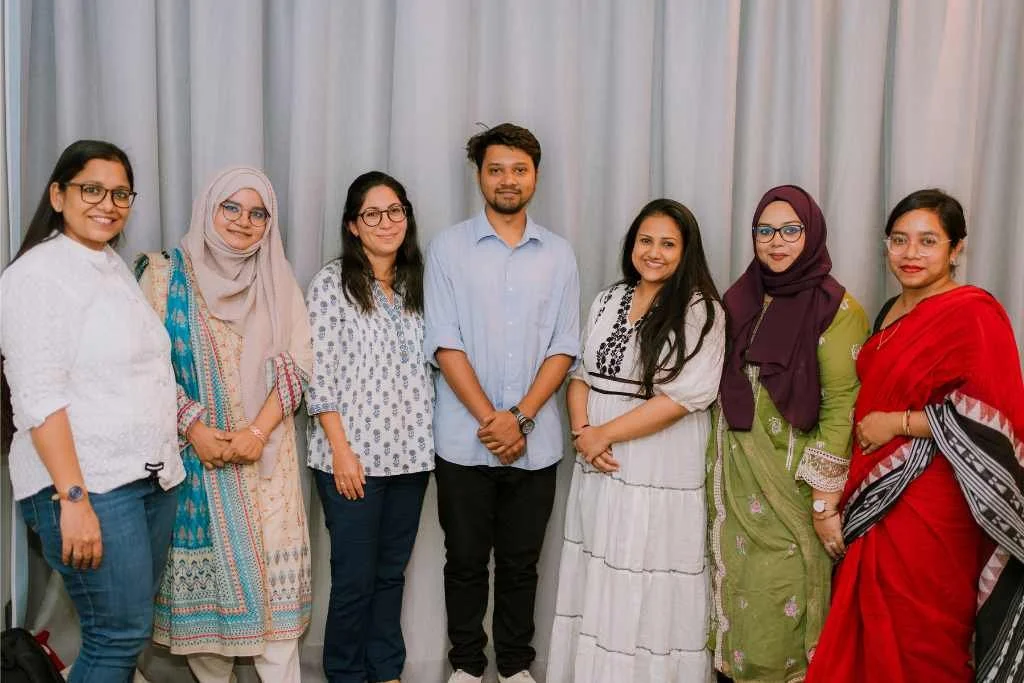
2025 Bay of Bengal Regional Convening
In CJRF’s Scottish Government-funded portfolio focused on Non-Economic Loss and Damage (NELD), we have made a deliberate choice to pair grantmaking with what we call accompaniment. Beyond providing grants, we have worked closely with partners to understand what kind of accompaniment they need to engage with these deep, often invisible losses across the Bay of Bengal, East Africa, and the Pacific.
What partners asked for: listening before designing support
When we took the time to listen, partners did not ask for skill building in the traditional sense. They asked for support to navigate the practical and ethical complexities of working with grief, memory, and loss.
Many partners shared that they needed help finding language to describe losses that are not about buildings or money. They spoke of the loss of mother tongues and ancestral languages, the fading of social cohesion, and the growing fear that a shared future is slipping away.
Partners also asked for ways to work with feminist and intersectional analysis that made sense in their own contexts. This meant engaging with gender in relation to caste, indigeneity, disability, age, marital status, and displacement as interconnected lived realities that shape how loss is experienced and addressed.
Perhaps most importantly, many named the emotional toll of this work. Documenting loss often means sitting with trauma and silence. This created a clear need for psychosocial support and trauma-informed care, both for community members sharing their stories and for staff holding them. Partners wanted to build evidence through storytelling, but to do so ethically, with meaningful consent and community ownership, rather than simply meeting reporting requirements.
What accompaniment has looked like in practice
In response, we provided dedicated resources, typically between USD 10,000 and 12,000, alongside core grants. We did not hand over checklists. Instead, we spent time in dialogue, refining plans together and working through what pacing, care, and feasibility looked like in each context.
This accompaniment has been shaped through regular check-ins and honest reflection. It is grounded in a commitment to shared power and to partners leading their own work.
Gender and intersectionality have been central to this effort: we paired ongoing mentoring with the hiring of local gender consultants in the Bay of Bengal and the Pacific, and this practice is now underway in East Africa. Having gender specialists as resource partners has allowed partners to integrate these lenses into their work in ways that felt organic and meaningful, rather than treating gender as a procedural requirement.
On the ground, partners used these capacity bridging funds for several vital areas:
Cultural preservation and memory work: Partners identified climate-driven erosion of culture, language, rituals, art forms, and indigenous knowledge as profound forms of non-economic loss. Capacity bridging supported community-led museums, cultural archives, community protocols for protecting biodiversity, and intergenerational knowledge processes, shaped and led by partners themselves.
Storytelling, documentation, and communication: Partners strengthened video documentation, oral histories, journalism, visual storytelling, and knowledge management. This included mentoring for storytellers and journalists, support for in-house gender co-mentors, and investments in partner-defined documentation and communication systems.
Advocacy and evidence translation: Accompaniment supported partners to connect lived experience to advocacy strategies through convenings, dialogue spaces, and narrative development. Partners decided if, when, and how to engage policy spaces, with accompaniment attentive to timing, care, and how they wanted to step into the spotlight.
Peer learning and collective sense-making: Cross-regional peer learning exchanges created space for partners to learn from one another across contexts. These spaces supported reflection on both divergence and convergence in experiences, approaches, and ethical questions related to non-economic loss and damage.
We prioritised accompaniment because we respect the leadership and knowledge of our partners. Listening takes time, and it requires humility to recognise that learning and care are essential capacities in work on non-economic loss and damage. We see our role as walking alongside people already engaged in difficult, politically charged work, offering support as they navigate it.
What we are learning so far
A few lessons are becoming clear as we move forward:
We have seen that accompaniment for non-economic loss and damage is, at its core, is an act of solidarity. The choices we make about whose stories are told and how they are shared ultimately shape whose knowledge is recognised by the world.
We also know that partners need time, safe space for dialogue, and accompaniment to work through how the lens of intersectionality operates within their specific cultural and institutional contexts, for example, how gendered experiences of loss intersect with caste, indigeneity, disability, age, or displacement in shaping who is most affected, who is heard, and whose knowledge and priorities carry power.
Finally, we are learning that the act of learning is a capacity in itself. Creating space to pause, reflect, and adjust, especially when working with cultural harm and trauma, sits at the centre of responsible non-economic loss and damage work.
As more funders engage with loss and damage, our experience suggests that accompaniment must remain central to grantmaking. Modest, flexible resources, combined with a commitment to listening and connecting across contexts, help ensure this work stays humane, accountable, and grounded in the realities of the communities it seeks to support.